Ad-blocker Detected - Your browser has an ad-blocker enabled, please disable it to ensure your attendance is not impacted, such as CPD tracking (if relevant). For technical help, contact Support.
Advances in ENT Surgery & innovation
77th ASOHNS Annual Scientific Meeting 2027
19 - 21 March 2027
Adelaide Convention Centre, Adelaide, South Australia
Adelaide Convention Centre, Adelaide, South Australia
ASOHNS 2027 Invitation
President's Invitation
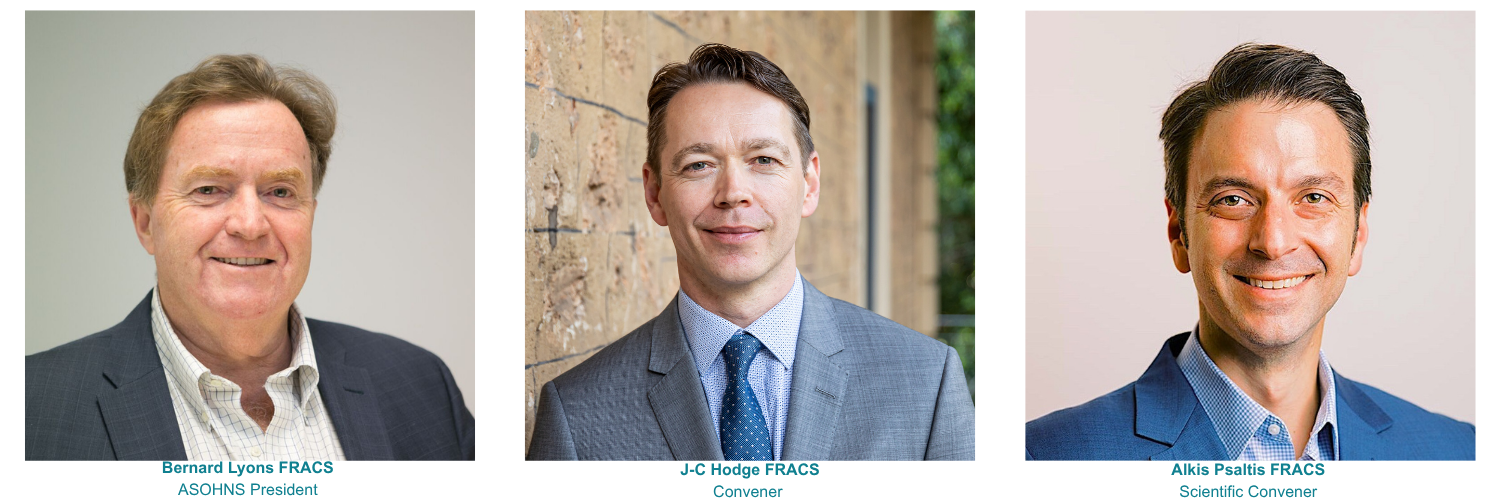
On behalf of ASOHNS, it is my pleasure to invite you to join us for the ASOHNS Annual Scientific Meeting, scheduled to take place in Adelaide, South Australia, from the 19th to the 21st of March 2027.
This meeting will be convened by Associate Professor John-Charles (J-C) Hodge and Professor Alkis Psaltis. The 2027 program is already taking shape and will be one not to miss. Adelaide has always been at the forefront of state-of-the-art research and clinical practice in the fields of head and neck surgery, rhinology, sleep medicine and surgery and facial plastic surgery so I am sure we can look forward to a memorable and professionally worthwhile experience.
Adelaide, renowned as the city of churches, has much to offer form a cultural and tourism point of view. Feel free to take in all that Adelaide has to offer including its historic buildings and impressive sports precinct. Adelaide’s beaches are close by as are several world class golf courses. The Adelaide Hills and famous wine regions are easily accessible for day trips, so why not extend your visit to take in some of the best food and wine that South Australia has to offer.
The ASOHNS annual meeting provides us with the opportunity both to meet for the first time in some cases and also to renew old acquaintances and interact with colleagues. These meetings also provide unrivalled opportunities to allow us exposure to the best local knowledge as well as world leading international keynote speakers. Attendance at these conferences is important to help us all meet our CPD requirements.
So keep up to date with everything that is going on with our specialty and we look forward to welcoming you to what promises to be an engaging and memorable event. Please save the date and look out for further details regarding registration, abstract submissions, and program highlights.
Bernard Lyons FRACS
ASOHNS President
Conveners' Invitation
On behalf of the Organising Committee, it is our great pleasure to welcome you to the 77th ASOHNS Annual Scientific Meeting, to be held in Adelaide, South Australia, from Friday to Sunday in March 2027.
We are delighted to bring the Annual Scientific Meeting to Adelaide – a vibrant, accessible city with outstanding food, wine regions nearby, and a rich cultural life – at a time when our specialty is rapidly evolving.
This year’s program has been curated to showcase cutting edge innovations in ENT surgery alongside rigorous, evidence-based discussion of the common conditions we see every day.
International and local experts will present novel techniques, new technologies, and translational research, while panels and workshops will focus on translating evidence into safe, effective patient care.
Our goal is to create a program that inspires practical advances in surgical practice, sharpens clinical decision making, and fosters collaboration across trainees, clinicians, researchers and community practitioners.
We also hope the meeting provides time to reconnect with colleagues, exchange ideas, and recharge in Adelaide’s welcoming atmosphere. Please take the opportunity to explore the city’s culinary scene, nearby wine regions, and cultural attractions during your stay.
We look forward to your participation, your questions, and your contributions to what promises to be an engaging, stimulating and practice changing meeting.
We are delighted to bring the Annual Scientific Meeting to Adelaide – a vibrant, accessible city with outstanding food, wine regions nearby, and a rich cultural life – at a time when our specialty is rapidly evolving.
This year’s program has been curated to showcase cutting edge innovations in ENT surgery alongside rigorous, evidence-based discussion of the common conditions we see every day.
International and local experts will present novel techniques, new technologies, and translational research, while panels and workshops will focus on translating evidence into safe, effective patient care.
Our goal is to create a program that inspires practical advances in surgical practice, sharpens clinical decision making, and fosters collaboration across trainees, clinicians, researchers and community practitioners.
We also hope the meeting provides time to reconnect with colleagues, exchange ideas, and recharge in Adelaide’s welcoming atmosphere. Please take the opportunity to explore the city’s culinary scene, nearby wine regions, and cultural attractions during your stay.
We look forward to your participation, your questions, and your contributions to what promises to be an engaging, stimulating and practice changing meeting.
Warm regards,
J-C Hodge FRACS Alkis Psaltis FRACS
Convener Scientific Convener
J-C Hodge FRACS Alkis Psaltis FRACS
Convener Scientific Convener